The 90s Childhood: Why We Flipped the Main Breaker to Get Our Kids Outside
Do you remember what boredom felt like? We recently flipped the main breaker on a Sunday afternoon out of sheer desperation — and it turned into one of the best family days we have had in months.
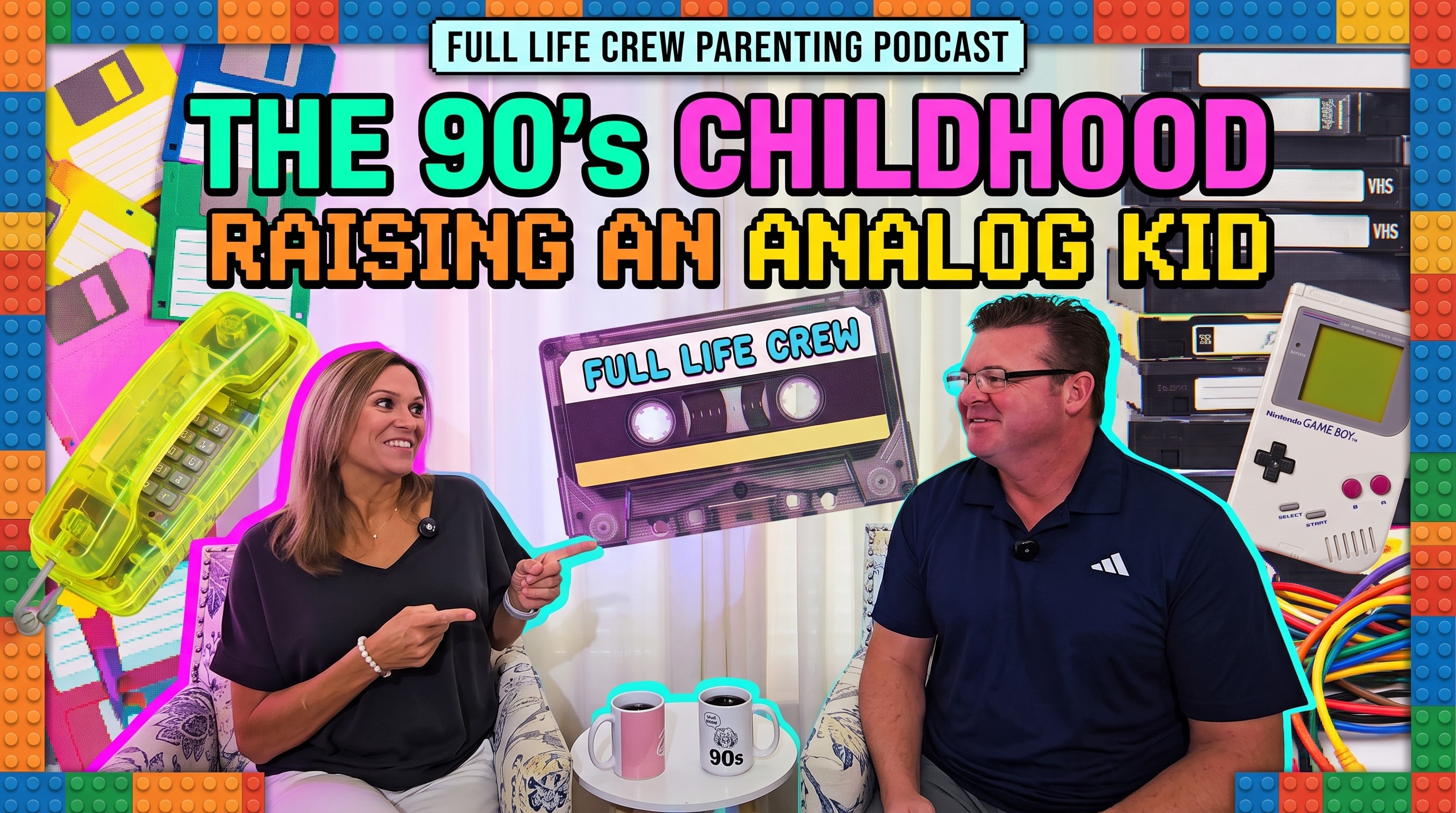
Do you remember what boredom felt like? If you grew up in the 90s, boredom was a physical sensation. It was the heavy, dragging feeling on a Tuesday afternoon during summer break that eventually forced you to go outside, build a questionable ramp out of scrap wood, and attempt to jump your bike over the neighborhood creek. We didn't have algorithms feeding us endless streams of entertainment; we had a clear plastic landline phone, a tangled cord, and the hope that a friend was actually home to answer.
Today, raising kids in a hyper-connected world feels like an entirely different sport. We recently sat down on the Full Life Crew Parenting Podcast to talk about this exact cultural shift in our episode, The 90's Childhood: Raising an Analog Kid. But the inspiration for this conversation didn't come from a parenting book — it came from a Sunday afternoon of sheer desperation.
Watch the full episode on YouTube — click the image above.
The Day the Power "Mysteriously" Went Out
A few weekends ago, Deborah and I looked around our living room and realized it looked like a sci-fi movie. It was a beautiful Sunday, but the house was dead silent. With eight kids, silence is rarely a good thing, and in this case, it was the eerie, glowing quiet of complete digital hypnosis. Everyone was sprawled across the couches and rugs, glued to a phone, a tablet, or a console.
We tried the gentle approach. "Who wants to go outside?" Groans. "Let's play a board game!" Ignored.
So, I walked out to the garage, opened the electrical panel, and flipped the main breaker.
Click.
The Wi-Fi router died. The TVs went black. The charging cables stopped working. Within thirty seconds, the house erupted. You would have thought we had just initiated a survival situation. Kids emerged from their digital caves, blinking at the natural sunlight, demanding to know what happened to the internet.
We played dumb for a little while, blaming the power company, before finally suggesting that since the house was "broken," we might as well go into the backyard. What started as forced exile slowly shifted into actual family time. The phones were put away, a football was thrown around, and we ended up having one of the best, most connected afternoons we've had in months.
The 90s Childhood vs. Today's Reality
That afternoon highlighted the massive gap between how we grew up and what our kids are experiencing. In the 90s, tech was a destination — you went to the desktop computer in the family room to play Oregon Trail, and then you walked away. Today, tech is an environment. It surrounds our kids constantly, removing the friction and the beautiful, creative boredom that forced our generation to figure out how to entertain themselves.
We aren't anti-technology. But today's childhood is incredibly curated and insulated. When everything is on-demand, kids miss out on the vital skills of waiting, wondering, and simply existing in a space without immediate stimulation. The 90s childhood was built on analog experiences: scraped knees, neighborhood negotiations, and making your own fun out of nothing.
Raising an Analog Kid
You don't have to throw away all your screens to raise an analog kid in a digital world. It is really about manufacturing those boundaries that used to exist naturally. It means intentionally flipping the metaphorical (or literal) breaker every now and then to force a reset. It is about prioritizing eye contact over screen time and making space for the messy, unscripted moments that only happen when the devices are powered down.
We dive deep into all of this — including our favorite 90s nostalgia moments — on the latest podcast episode. Watch it below:
What is one rule or boundary you've put in place in your home to help disconnect and get back to those "analog" roots?

Explore Topics
Written by
Jareth & Deb
Content creator and writer sharing insights and stories.


